

- AI video and image tools have compressed production timelines by up to 68%, with top teams now generating full campaign variations in hours instead of weeks.
- AI-driven campaigns deliver 22% higher ROI, 32% more conversions, and 29% lower acquisition costs compared to traditionally produced creative.
- LTX Studio gives marketing teams everything they need in one place — from multi-model generation to character consistency, motion control, and multi-language versioning.
The way brands create content has fundamentally changed. What once required studios, production crews, and weeks of post-production can now be accomplished in hours — from a single platform, by a team of two. AI-generated videos and images aren't a future trend marketers need to prepare for.
They're the current state of how the best teams are operating right now.
In 2026, the question isn't whether to use AI in your marketing creative. It's how fast you can build the workflows to do it well.
Why Visual AI Is Changing How Brands Market
For decades, high-quality visual content was gated behind budget and production infrastructure. You needed cameras, studios, editors, talent, and time. That kept a lot of creative ambition on the shelf.
AI has dismantled that constraint entirely. The result is a creative landscape where the bottleneck has shifted — it's no longer what you can afford to produce. It's how quickly you can direct and iterate.
The scale of adoption confirms this shift is structural, not cyclical. 87% of creative professionals now use AI tools for video creation, with 66% using them weekly. 78% of marketing teams now use AI-generated video in at least one campaign per quarter, and 73% of Fortune 500 companies have integrated AI video tools into their content workflows.
The reason is straightforward: visual content has never been more central to how audiences engage with brands. 84% of consumers want to see more video content from brands, and 89% say video quality directly impacts their trust in a brand.
At the same time, 63% of people say they'd most like to watch a short video when learning about a product or service. Brands that can't produce video at scale are simply not meeting their audiences where they are.
In 2026, professional polish is no longer a competitive advantage — it's table stakes. When the barrier to creating polished work is zero, the barrier to being memorable is higher than ever. Creative direction and strategic vision now matter more than budget or technical skill.

How AI Videos and Images Improve Marketing Performance
The case for AI-generated creativity isn't just about cost savings — it's about what becomes possible when production cycles compress and creative volume scales.
Speed to market. Companies using AI video report a 68% faster time-to-publish for their video marketing campaigns. For teams running multi-channel campaigns across social, paid, email, and web, that acceleration is a genuine competitive advantage.
Creative volume and variation. One of the most immediate gains from AI visual tools is the ability to generate and test more variations faster. Instead of committing a full production budget to one creative concept, teams can generate multiple directions, test them in-market, and double down on what performs. AI-generated creatives increase click-through rates by 47% compared to traditionally produced ads.
Character and brand consistency at scale. Marketing teams are now generating entire campaign variations in hours by reusing consistent characters across different contexts, messages, and visual styles without quality degradation.
What once required matching talent, wardrobe, and lighting across multiple shoot days can now be managed through saved Elements and brand references inside an AI platform.
Personalization without proportional cost. AI enables teams to create localized, audience-specific, or format-specific versions of the same asset without restarting production from scratch. A hero video can be reformatted, re-voiced, and re-captioned for different markets or segments at a fraction of traditional localization costs.
Audience demand is already there. Short-form AI videos under 60 seconds generate 2.7x more engagement than static content — and audiences are increasingly indifferent to the production method, as long as the content is compelling.
AI-Generated vs. Traditional Creative: Performance
The performance gap between AI-assisted creative and traditional production methods has become measurable and significant.
AI-driven campaigns deliver 22% higher ROI, 32% more conversions, and 29% lower acquisition costs compared to traditional methods. For marketing organizations running large paid media programs, those numbers represent real budget efficiency and real revenue impact.
On production economics, the contrast is even starker. AI video tools reduce average production costs by 91% compared to traditional video production — not because quality has been sacrificed, but because the fixed infrastructure costs of traditional production have been eliminated.
The shift is also redefining how marketing teams allocate their time. In organizations using AI-driven marketing operations, 75% of staff effort has shifted from production to strategy.
Marketers are spending less time executing repetitive production tasks and more time on the decisions that actually move the needle — creative direction, audience strategy, and campaign optimization.
That said, performance isn't automatic. Audiences can detect generic content immediately, and the brands winning with AI are the ones that bring a clear point of view, a quality bar, and refined creative taste to their AI workflows. AI handles the production lift. Humans still drive the strategy and the story.
The brands pulling ahead aren't those with the biggest AI budgets — they're the ones who rebuilt their creative workflows around AI early. The gap between those teams and the ones still running traditional production pipelines is already measurable. And it's widening.
How to Use LTX Studio's AI Tools to Transform Your Marketing
LTX Studio is built for exactly this shift — a platform where marketers, agencies, and creative teams can take a project from concept to commercial-ready output without bouncing between tools or handing work off to a production team.
The starting point is Gen Space, where generation actually happens. Teams can choose from a range of image and video models — including LTX-2.3, Kling 3.0 Pro, Veo 3.1, FLUX.2 Pro, and Nano Banana 2 — depending on the creative goal. Cinematic storytelling, fast social content, photorealistic stills: different jobs call for different models, and they're all in one place.
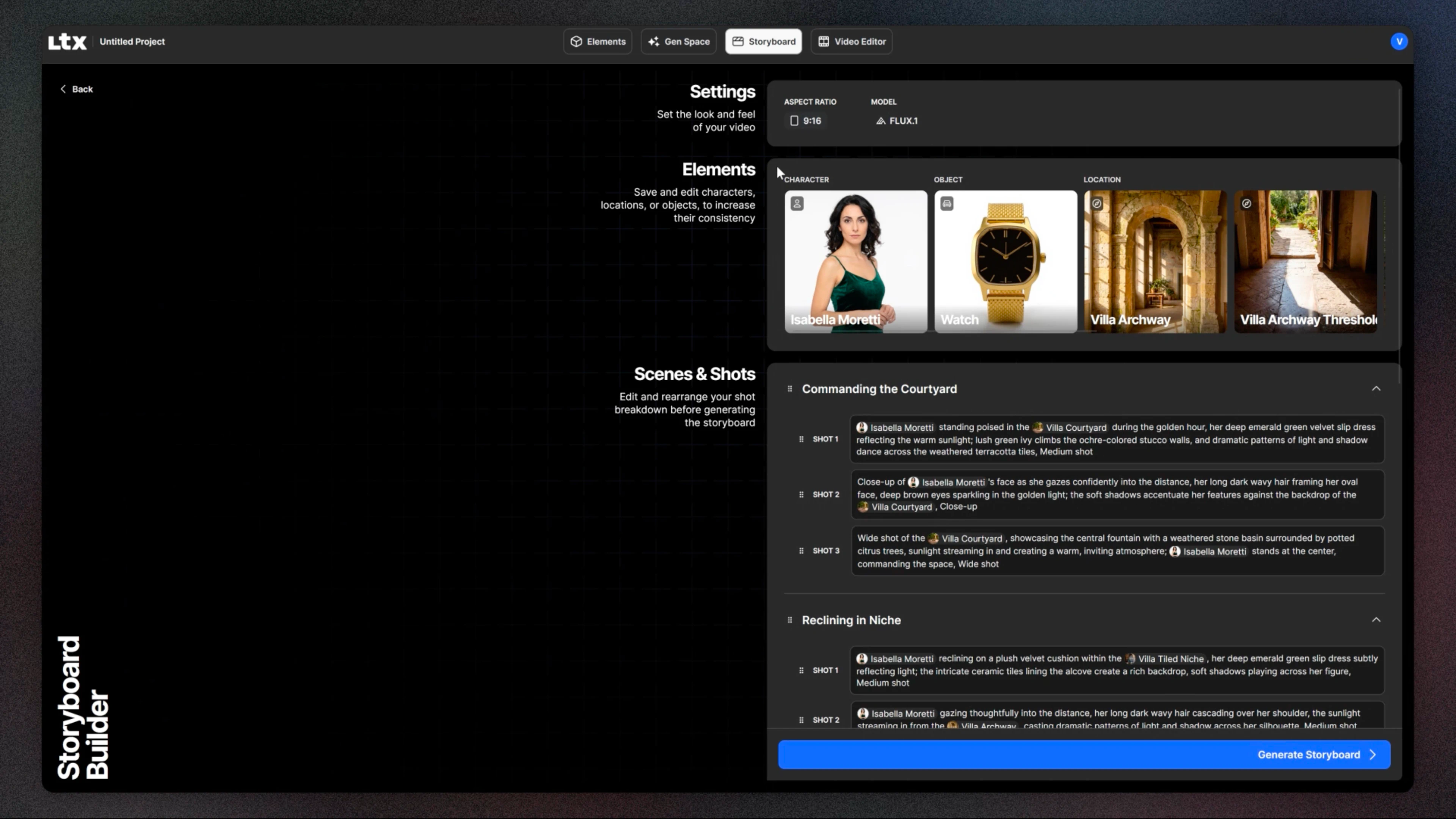
What makes LTX Studio useful for marketing specifically — not just content creation — is how it handles consistency and scale. Elements let teams save characters, objects, and visual styles as reusable assets, so the same brand character can appear across dozens of scenes without losing visual fidelity.
AI Storyboards let teams plan and validate a full sequence before committing to animation, so creative decisions happen early rather than expensively late.
For teams who need more than static imagery, Motion Control adds a level of precision that text prompting alone can't deliver. By uploading a reference video, creators can transfer real movement — body motion, gestures, pacing — directly onto a character, replacing guesswork with direction.
Audio-to-Video works in a similar vein: drop in a voiceover or audio track, and LTX Studio generates synchronized video to match, cutting a step out of the production loop entirely.
For enterprise teams operating across markets, multi-language video versioning means localized content doesn't require rebuilding campaigns from scratch for each region — a meaningful advantage for any brand managing global distribution at scale.
Conclusion
AI videos and images have moved from a production novelty to a marketing infrastructure. The teams that treat AI visual creation as a core part of their workflow — not an experiment on the edge of it — are already seeing faster time-to-market, stronger creative performance, and significantly lower production costs.
The shift isn't about replacing creative thinking. It's about removing the production ceiling that used to sit above it.
LTX Studio gives marketing teams, agencies, and brand studios the tools to generate, direct, iterate, and scale visual content — all in one place. The creative ambition doesn't have to change. The infrastructure around it does.


Maximize your creative potential with AI-powered tools
Maximize your creative potential with AI-powered tools








.png)